
Indiana BMV Motorcycle Practice Test 5
Test 5 of 6. Pick an answer for each question to see if it is right and why; your score appears at the end. You need 20 correct answers to pass, the same ratio as the real Indiana test.

- Questions25
- Correct to pass20
- Passing score80%
- Minimum age16 years and 90 days
-
1. When must an Indiana vehicle display lighted head lamps?
Show answer
Answer C: From sunset to sunrise, and whenever people are not clear at 500 feet
Lighted head lamps are required from sunset to sunrise and at any other time when persons and vehicles on the highway are not clearly discernible at 500 feet ahead.
-
2. How does riding in a formation change your responsibility for your own space cushion?
Show answer
Answer C: It does not change it, because each rider still manages their own space and decisions
A formation organizes the group, but every rider remains responsible for their own following distance, escape paths and riding decisions.
-
3. You are driving at night through heavy falling snow. Which headlight setting works better and why?
Show answer
Answer C: Low beams, because high beams bounce off the falling flakes back at you
Falling snow reflects light the way fog does, so high beams build a white wall of glare while low beams still give a usable view.
-
4. You are following a car at night with the high beam on. What should you do?
Show answer
Answer C: Switch to the low beam so the driver ahead is not blinded
A high beam fills the mirrors of the vehicle ahead and blinds its driver, which is dangerous for the very driver most able to affect the rider.
-
5. What is the safest way to deal with the situation this sign announces?

Show answer
Answer B: Match the speed of the other traffic stream and open a gap so vehicles can blend without hard braking
Blending works when speeds are matched and gaps are opened, so nobody has to brake hard or swerve where the two streams come together.
-
6. A signal on an entrance ramp changes from red to green and lets one vehicle at a time onto the highway. What should you do?
Show answer
Answer A: Stop on the red and go on the green, one vehicle for each green
A ramp meter spaces vehicles out so they join the highway one at a time instead of arriving as a group, and it is a traffic signal like any other.
-
7. What is the best way to keep your phone from distracting you on a trip?
Show answer
Answer D: Silence it and stow it before you start
A phone you cannot hear and cannot reach cannot tempt you, which is far more reliable than deciding case by case while you drive.
-
8. A vehicle coming toward you has drifted into your lane. What should you do?
Show answer
Answer D: Slow down, sound the horn, flash your lights and steer to the right if possible
Moving right gives the other driver space to recover and keeps you out of the lane they are most likely to return to. Braking reduces the force of any impact.
-
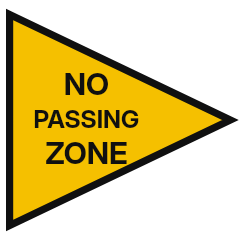
9. Where does the restriction that starts at this sign come to an end?
Show answer
Answer D: Where the centerline markings show that overtaking is allowed again
The sign marks the start of the restricted section, and the centerline markings along the road show how far it runs and where overtaking becomes lawful again.
-
10. An emergency vehicle with flashing lights and a siren is approaching from behind on a two-way street. What should you do?
Show answer
Answer C: Pull over to the right edge of the road and stop until it passes
Clearing a path by pulling to the right and stopping gives the emergency vehicle a predictable route, while stopping in mid-lane or inside an intersection blocks that path.
-
11. Does Indiana's move over duty apply to a tow truck or highway maintenance vehicle showing amber flashing lights?
Show answer
Answer B: Yes, drivers must change lanes away or slow to 10 mph under the limit, and failure is a Class B infraction
Indiana extends the move over duty to authorized parked vehicles with amber flashing lights, such as tow trucks, highway maintenance, utility, solid waste and survey vehicles, and to disabled vehicles showing hazard lights, with failure treated as a Class B infraction.
-
12. Without a depth gauge, how can a rider tell that a tire has worn out?
Show answer
Answer A: The tread has worn down level with the wear bars set into the grooves
Wear bars are molded across the bottom of the tread grooves, and once the tread surface reaches them the tire has no usable depth left.
-
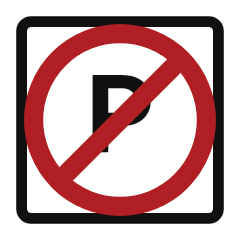
13. A driver leaves the vehicle at the curb where this sign is posted and walks away for two minutes. Is that allowed?
Show answer
Answer B: No, leaving the vehicle unattended there is prohibited whatever the length of the absence
Walking away leaves the vehicle parked, and the prohibition holds regardless of how long the driver is gone or whether the engine is left running.
-
14. How many points does Indiana assess for disregarding a stop sign or a yield sign?
Show answer
Answer A: Four points
Disregarding a stop sign or a yield sign is a four point violation on Indiana's point schedule.
-
15. Which restrictions apply to operating a motor driven cycle in Indiana?
Show answer
Answer D: At least 15 years old, helmet and eye protection if under 18, maximum 35 mph, no passengers and no interstate or sidewalk use
Indiana defines a motor driven cycle as having an engine of 50 cubic centimeters or less and restricts operators to age 15 or older, helmet and eye protection under 18, a 35 mile per hour maximum, no passengers, and no operation on interstates or sidewalks.
-
16. What fine does Indiana impose for a third worksite speed limit violation within three years?
Show answer
Answer D: One thousand dollars
A driver with two or more prior worksite speeding infractions in the previous three years receives a fine of one thousand dollars.
-
17. Within what period must a chemical test be administered after an Indiana officer has probable cause?
Show answer
Answer B: Three hours
A chemical test under the implied consent law must be administered within three hours after the officer had probable cause.
-
18. You are parking on a one-way street where parking is allowed on both sides. What must still be true?
Show answer
Answer D: The vehicle must face the direction the traffic flows
Either curb may be used on a one-way street where signs allow it, but the vehicle must always be headed in the direction traffic moves.
-
19. What does Indiana's move over statute say about a driver who has complied with it?
Show answer
Answer B: The driver still owes a duty of due regard for everyone using the highway
The statute states that nothing in the section relieves a driver from the duty to operate with due regard for the safety of all persons using the highway.
-
20. Is dictating a message by voice a safe alternative to typing one?
Show answer
Answer C: No, it still takes attention from driving
Composing and checking a spoken message loads the mind and usually pulls the eyes to the screen anyway, so research finds it no safer than other phone use.
-
21. How does becoming chilled affect a rider before any shivering is obvious?
Show answer
Answer D: It slows reactions and clouds judgment while the rider still feels fine
Cooling degrades reaction time and decision making before the rider notices it, so dress for the coldest part of the ride and stop to warm up rather than pressing on.
-
22. What must a motorcycle be equipped with before it can safely carry a passenger?
Show answer
Answer B: A seat large enough for two people and a set of passenger footrests
A passenger needs a seat with room for both people without crowding and firm footrests to brace against.
-
23. A wide solid white line separates the through lanes from an exit lane. What does it tell drivers?
Show answer
Answer B: The choice of lane should already have been made
A channelizing line marks where the paths separate and crossing it is discouraged or prohibited, so the lane change has to happen upstream.
-
24. What are painted curb markings mainly used for?
Show answer
Answer D: Conveying parking and stopping regulations
Colored curbs tell drivers where waiting or parking is restricted, and because the exact color meanings are set locally a driver should also read the posted signs.
-
25. What does Indiana law make of a move over violation that seriously injures someone at an emergency vehicle?
Show answer
Answer A: A Level 6 felony
Failing to comply with the emergency vehicle move over duty is normally a Class A infraction, but it becomes a Level 6 felony where it causes serious bodily injury, catastrophic injury or death.