
Indiana BMV Motorcycle Practice Test 2
Test 2 of 6. Pick an answer for each question to see if it is right and why; your score appears at the end. You need 20 correct answers to pass, the same ratio as the real Indiana test.
- Questions25
- Correct to pass20
- Passing score80%
- Minimum age16 years and 90 days
-
1. On an Indiana rural interstate highway, what maximum speeds apply to passenger vehicles and to heavy trucks?
Show answer
Answer B: 70 miles per hour for passenger vehicles and 65 for trucks over 26,000 pounds declared gross weight
Indiana caps passenger vehicles at 70 miles per hour on rural interstates and heavy trucks with a declared gross weight over 26,000 pounds at 65 miles per hour.
-
2. An Indiana vehicle is 86 feet long. What maximum speed applies to it?
Show answer
Answer B: 55 miles per hour
A vehicle exceeding 10 feet 6 inches in width, 13 feet 6 inches in height, or 85 feet in length may not be driven faster than 55 miles per hour.
-
3. Why do experienced riders squeeze the clutch lever while starting the engine, even with the neutral light showing?
Show answer
Answer A: In case a gear is engaged, so the motorcycle cannot lurch forward
A neutral light can be wrong, and a disengaged clutch means the machine stays still even if the transmission is actually in gear.
-
4. After an hour on a hot highway your tire pressure reads higher than it did in the morning. What should you do?
Show answer
Answer D: Nothing, because pressure rises when tires heat up
Air expands as the tire warms, so a hot reading is normally above the cold setting. Bleeding air off would leave the tire underinflated once it cooled.
-
5. In Indiana, how long are driving privileges suspended for failing a chemical test compared with refusing one?
Show answer
Answer A: 180 days for failing the test and one year for refusing it
Indiana suspends driving privileges for 180 days when a motorist fails a chemical test and for one year when a motorist refuses it, rising to two years for a refusal by someone with a previous operating while intoxicated conviction.
-
6. Cones and drums mark a shifted lane through a work zone. What should you do?
Show answer
Answer A: Follow the path that they mark and stay inside it
Channelizing devices define the temporary travel path, and the space on the other side of them belongs to the workers.
-
7. Why is parking against the flow of traffic dangerous even when nobody complains?
Show answer
Answer D: Because you had to cross traffic to get there and must cross again to leave
Parking on the wrong side means driving against traffic at both ends of the stop, and your reflectors and lights face the wrong way while you are there.
-
8. You are entering a marked school zone during the posted hours. What should you do?
Show answer
Answer A: Slow to the school zone limit and watch for children
The school zone limit applies throughout the posted hours, whether or not you can see any children at that moment.
-
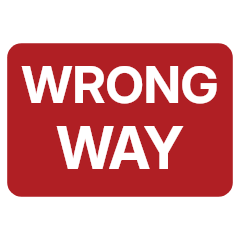
9. At a freeway exit ramp, this sign normally backs up which other regulatory sign posted nearer to the ramp terminal?
Show answer
Answer D: The sign that forbids entering that roadway at all
The two work as a pair at ramp terminals: one keeps drivers from turning in, and this one sits farther along to catch a driver who has already entered.
-
10. How tight should the chin strap of a helmet be?
Show answer
Answer D: Snug under the jaw, tight enough that the helmet cannot be pulled off
A helmet only works if it stays on, so the strap must be fastened snugly under the jaw on every ride, including short ones.
-
11. A pedestrian with a white cane draws the cane back and steps away from the curb as you approach. What does that usually mean?
Show answer
Answer B: They are signaling you to go ahead and drive on
Pulling the cane in and stepping back from the curb is the customary way a blind pedestrian tells drivers to proceed.
-
12. On dry pavement in good weather, what is the smallest following gap you should keep?
Show answer
Answer A: About three seconds behind the vehicle ahead
Three seconds is the accepted minimum on dry roads in good visibility, and the gap should be longer in poor conditions.
-
13. Under Indiana's Move Over law, what must you do if you cannot change lanes away from an emergency vehicle with flashing lights?
Show answer
Answer A: Reduce speed to 10 miles per hour below the posted limit and proceed with caution
Indiana requires drivers to change lanes away from an emergency vehicle displaying flashing lights, and when that is not possible to slow to 10 miles per hour under the posted limit and proceed with caution.
-
14. How does a previous operating while intoxicated conviction within seven years affect a new Indiana charge?
Show answer
Answer C: It raises the new offense to a Level 6 felony
A violation committed within seven years of a previous operating while intoxicated conviction is charged as a Level 6 felony.
-
15. A driver who has been drinking has two cups of strong coffee. What has changed?
Show answer
Answer D: The driver is more awake but just as impaired
Coffee can make a drinker feel alert, but nothing except time removes alcohol from the blood, so a wide awake drinker is still an impaired driver.
-
16. You have finished a distracting task and your eyes are back on the road. What is true?
Show answer
Answer A: Your full attention takes a while to come back
Studies of drivers show attention lags behind the eyes for many seconds after a phone or a screen task, so the danger continues after the task is over.
-
17. A deer crosses the road ahead of you and disappears into the trees. What should you expect?
Show answer
Answer A: More animals may follow, since deer usually move in groups
Deer commonly travel in groups, so one animal crossing is a warning that others are close by. Slow down and stay ready to stop well past the point where it crossed.
-
18. School warning signs use which background and legend colors?
Show answer
Answer A: A black legend and border on a fluorescent yellow-green background
School warning signs carry a black legend and border on a fluorescent yellow-green background, a shade chosen so they stand out from ordinary yellow warning signs.
-
19. What maximum speed does Indiana law set for driving in an alley?
Show answer
Answer A: 15 miles per hour
The statutory maximum in an alley is 15 miles per hour, and a local authority may raise it only as far as 20.
-
20. A sign showing a walking figure inside a red circle with a diagonal slash stands at the start of a bridge. What does it mean?
Show answer
Answer C: People on foot may not use that roadway
The no pedestrians sign excludes people on foot from that roadway altogether, which is common on high-speed bridges and freeways.
-
21. You are inside a tunnel with no shoulder when an ambulance comes up behind you with lights and siren. What should you do?
Show answer
Answer D: Keep going at a safe speed and pull over once you are clear of the tunnel
Stopping in a tunnel or on a narrow bridge blocks the only lane, so continue at a safe speed to the first place where you can pull clear.
-
22. How should a rider adjust speed on an unlit road at night?
Show answer
Answer C: Slow enough to stop within the distance the headlight actually lights up
A rider can only react to what is visible, so night speed has to fit the distance the headlight reaches rather than the posted limit.
-
23. What are the two routes to obtaining an Indiana motorcycle endorsement?
Show answer
Answer A: Complete an approved Ride Safe Indiana training course, or pass both the motorcycle knowledge exam and the motorcycle skills exam
Indiana lets an applicant either provide proof of completing an approved Ride Safe Indiana motorcycle safety course or pass the motorcycle knowledge exam to obtain a learner's permit and then pass the skills exam.
-
24. What alcohol concentration puts an Indiana driver under 21 in violation of the zero tolerance rule?
Show answer
Answer A: At least 0.02 but less than 0.08
A driver under 21 who operates with an alcohol concentration of at least 0.02 but less than 0.08 commits a Class C infraction.
-
25. You are waiting inside the intersection to turn left when your light turns red. What should you do?
Show answer
Answer A: Complete the turn as soon as the way is clear
Once you have legally entered the intersection you should clear it as soon as the oncoming traffic has stopped, rather than sit in the path of cross traffic.