
Indiana BMV Permit Practice Test 5
Test 5 of 10. Pick an answer for each question to see if it is right and why; your score appears at the end. You need 40 correct answers to pass, the same ratio as the real Indiana test.
- Questions50
- Correct to pass40
- Passing score80%
- Minimum age15 years
-
1. You face a red light at an intersection that has no stop line and no marked crosswalk. Where must you stop?
Show answer
Answer C: Before entering the intersection
With no line and no crosswalk, the stopping point is the near edge of the intersecting roadway, close enough to see cross traffic but clear of it.
-
2. What happens to an Indiana minor's permit or license if the adult who signed for financial liability withdraws?
Show answer
Answer C: It is cancelled, and the minor must reapply with a new person to sign
A written request to cancel financial liability cancels the minor's learner's permit or driver's license, so the minor must apply for an amended credential with a new signer.
-
3. Which record makes an Indiana habitual violator suspension a lifetime suspension?
Show answer
Answer B: Two judgments in ten years for causing a death with a prohibited alcohol concentration
Two judgments within ten years for operating while intoxicated resulting in death, or for causing death with a prohibited alcohol concentration, bring a lifetime suspension.
-
4. You have a green left-turn arrow but a pedestrian is still walking in the crosswalk you must cross. What should you do?
Show answer
Answer B: Wait until the crosswalk is clear before turning
A green arrow protects you from other vehicles, but it never removes the duty to yield to a person already in the crosswalk.
-
5. A fire truck with lights and siren has just passed you and is heading down the same road. How closely may you follow it?
Show answer
Answer B: Well back, because following a responding emergency vehicle closely is illegal
Following a responding emergency vehicle closely is prohibited; the exact minimum distance is set by each state, so stay far enough back to keep the scene and other responders clear.
-
6. As speed rises, which part of the total stopping distance grows the fastest?
Show answer
Answer B: The braking distance, which grows far faster than speed itself
Perception and reaction distances grow in step with speed, but braking distance grows roughly with the square of speed, so it dominates at higher speeds.
-
7. After holding an Indiana probationary license for 180 days, what night restrictions still apply to a driver under 18?
Show answer
Answer A: No driving Sunday through Thursday after 11 p.m., Monday through Friday before 5 a.m., or Saturday and Sunday between 1 a.m. and 5 a.m.
After 180 days, an Indiana driver under 18 may not drive after 11 p.m. Sunday through Thursday, before 5 a.m. Monday through Friday, or between 1 a.m. and 5 a.m. on Saturday and Sunday.
-
8. Besides motorist services and tourist information, a blue sign background is also used for
Show answer
Answer B: evacuation route signing
Blue is assigned to road user services, tourist information and evacuation routes, so hurricane and other evacuation routes are signed in blue.
-
9. A regulatory sign posted at the start of a road reads LENGTH LIMIT 30 FEET. What does it control?
Show answer
Answer B: The overall length of vehicle allowed on that road
Some states post a length limit where tight curves or narrow structures lie ahead; it bars vehicles or combinations longer than the figure shown from using that road.
-
10. A driver is following you far too closely and you have a turn coming up. How should you slow down for it?
Show answer
Answer B: Signal early and slow gradually well before the turn
Early signals and gentle braking give a tailgater the time and distance they have failed to leave for themselves.
-
11. You are in the open lane where another lane is merging into yours. What is your part in the merge?
Show answer
Answer A: Keep a steady speed and leave a gap for one vehicle to come in
A merge works when each driver in the through lane lets one vehicle in, which keeps both lines moving instead of stopping them both.
-
12. What offense does an Indiana driver commit by recklessly passing a school bus whose stop arm is extended?
Show answer
Answer D: A Class A misdemeanor
Recklessly passing a stopped school bus with the arm signal extended is a Class A misdemeanor, rising to a Level 6 felony for bodily injury and a Level 5 felony for a death.
-
13. You are stopped at an intersection where bushes block your view of cross traffic. What should you do?
Show answer
Answer A: Edge forward slowly until you can see, then proceed when clear
Creeping forward a little at a time lets you gain a view without committing to the crossing. Never enter an intersection you cannot see into.
-
14. Why should heavy objects in the passenger compartment be secured?
Show answer
Answer A: Because loose objects fly forward in a crash and can injure the people
Anything loose keeps traveling at the speed of the vehicle when the vehicle stops, so it strikes the occupants with great force.
-
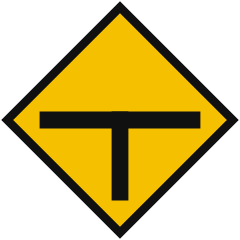
15. What must a driver be prepared to do at the point this sign refers to?
Show answer
Answer D: Turn left or right, because the road being traveled ends there
The road ends at another roadway, so the driver must slow, give way to traffic on the through road and turn in one direction or the other.
-
16. How long is an Indiana learner's permit issued as a physical credential valid?
Show answer
Answer D: Two years from the date of issuance
A learner's permit issued in the form of a physical credential expires two years after the date of issuance.
-
17. You are turning left out of a driveway onto a busy two-way street. What must you do?
Show answer
Answer D: Wait for a gap in both directions before you start to move
The turn crosses one direction of traffic and joins the other, so you need a gap in both before leaving the driveway rather than stopping across a lane.
-
18. There is a stop sign but no stop line and no crosswalk. Where must you stop?
Show answer
Answer A: Before entering the intersection, where you can see cross traffic
With no line or crosswalk, stop before you enter the intersection at the point where you can see traffic on the cross street.
-
19. Your light is green but the traffic beyond the intersection is stopped and there is no room on the far side. What should you do?
Show answer
Answer A: Wait behind the line until you can clear the far side
Entering an intersection you cannot clear blocks the cross traffic when their signal turns green, so you wait behind the line.
-
20. You brake hard on a wet road and need to steer around a stalled car. How do antilock brakes help you do that?
Show answer
Answer B: They stop the wheels locking, so the tires can still turn the vehicle
Locked wheels slide and cannot change direction. By preventing lockup the system lets you brake at full force and steer at the same time.
-
21. Your passengers are being noisy and you are losing concentration. What should you do?
Show answer
Answer B: Ask them to settle down, or pull over safely until they do
The driver is responsible for the conditions inside the vehicle, and stopping is always better than driving distracted.
-
22. You stop at the curb on a busy street to let passengers out. What should you tell them?
Show answer
Answer A: To get out on the curb side, away from traffic
Passengers should always leave on the side away from moving traffic, which keeps both them and the door out of the travel lane.
-
23. What suspension may an Indiana court add for a first violation of passing a school bus with its stop arm extended?
Show answer
Answer B: Ninety days
Passing a stopped school bus with the arm signal device extended is a Class A infraction, and the court may suspend driving privileges for ninety days, or for one year on a repeat.
-
24. You are on an entrance ramp joining a busy freeway. What should you do with your speed in the acceleration lane?
Show answer
Answer D: Build it up to about the speed of the traffic you are joining
Merging works when your speed matches the traffic stream, because a large speed difference forces the drivers already on the freeway to brake or swerve.
-
25. Does Indiana's move over duty apply to a tow truck or highway maintenance vehicle showing amber flashing lights?
Show answer
Answer B: Yes, drivers must change lanes away or slow to 10 mph under the limit, and failure is a Class B infraction
Indiana extends the move over duty to authorized parked vehicles with amber flashing lights, such as tow trucks, highway maintenance, utility, solid waste and survey vehicles, and to disabled vehicles showing hazard lights, with failure treated as a Class B infraction.
-
26. Enhanced reference location markers differ from ordinary mileposts in that they
Show answer
Answer B: carry the route number and a mileage figure to the tenth of a mile
An enhanced reference location marker adds the route designation and carries the mileage to a tenth, so the point named is far more precise than a plain milepost.
-
27. You are driving down a parking aisle and reach the main lane that runs along the front of the store. What is the usual rule?
Show answer
Answer C: The main through lane has the right of way over the vehicles leaving the aisles
In a parking lot the wide lane that runs across the ends of the aisles works like a through road, and drivers leaving an aisle yield to it.
-
28. Where is a road work ahead sign placed?
Show answer
Answer B: In advance of the work space or detour, so drivers are warned before reaching it
Advance warning signs are placed upstream of the work space or detour so that drivers have time to slow down and change lanes before reaching the activity.
-
29. A school sign combined with an AHEAD plaque, or with a plaque giving a distance in feet, forms an assembly that
Show answer
Answer B: warns of a school crossing located further along the road
The school advance crossing assembly is placed before the crosswalk to give drivers notice, while a different assembly marks the crossing itself.
-
30. Some toll facilities use signs and markings with a purple background or a purple stripe. What do they identify?
Show answer
Answer D: Lanes reserved for vehicles with an electronic toll account
Purple is assigned to lanes and ramps restricted to vehicles with a registered electronic toll collection account, so drivers without one must stay out.
-
31. You are first in the queue at a red light with a marked crosswalk. Where should your vehicle stop?
Show answer
Answer A: Behind the stop line, so that the crosswalk stays clear
Stopping short of the line keeps the crosswalk usable for people on foot and keeps your vehicle out of the path of turning traffic.
-
32. In Indiana, how long are driving privileges suspended for failing a chemical test compared with refusing one?
Show answer
Answer A: 180 days for failing the test and one year for refusing it
Indiana suspends driving privileges for 180 days when a motorist fails a chemical test and for one year when a motorist refuses it, rising to two years for a refusal by someone with a previous operating while intoxicated conviction.
-
33. You want to stop briefly and the only space is in the travel lane alongside a vehicle already parked at the curb. Is this allowed?
Show answer
Answer D: No, double parking blocks a travel lane and is prohibited
Stopping in the roadway beside a parked vehicle removes a lane from traffic and forces other drivers to swerve around you, which is why double parking is prohibited.
-
34. Does using a hands free device remove the risk of distraction?
Show answer
Answer A: No, the conversation still takes attention away from driving
Hands free equipment removes the manual part of the distraction but not the mental part, and a driver deep in conversation can look straight at a hazard without registering it.
-
35. On an Indiana rural interstate highway, what maximum speeds apply to passenger vehicles and to heavy trucks?
Show answer
Answer B: 70 miles per hour for passenger vehicles and 65 for trucks over 26,000 pounds declared gross weight
Indiana caps passenger vehicles at 70 miles per hour on rural interstates and heavy trucks with a declared gross weight over 26,000 pounds at 65 miles per hour.
-
36. Below a speed limit sign is a smaller panel with white numbers on a black background and the word NIGHT. What does it show?
Show answer
Answer D: The limit that applies after dark
A night speed limit panel sets a separate legal maximum for the hours of darkness, and its reversed colors mark it as the night figure.
-
37. Compared with dry pavement, how much room does a vehicle need to stop on packed snow?
Show answer
Answer D: Several times as much
Grip on packed snow is a fraction of that on dry pavement, so stopping distance grows several times over. Antilock brakes help you steer, not stop shorter.
-
38. You are parking facing uphill on a street with a curb. What is the correct wheel position?
Show answer
Answer B: Turn the front wheels away from the curb and let the vehicle roll back until a tire touches it
Facing uphill the vehicle would roll backward, so the wheels point away from the curb and the tire is rested against it to act as a block.
-
39. During the first 180 days with an Indiana probationary driver's license, when may the driver not drive?
Show answer
Answer D: Between 10 p.m. and 5 a.m.
For the first 180 days after a probationary license is issued, Indiana prohibits driving between 10 p.m. and 5 a.m., after which a looser schedule applies to drivers under 18.
-
40. An unpaid judgment over two hundred dollars arises from a crash. When does the Indiana BMV suspend the debtor's privileges?
Show answer
Answer D: After the person has failed for ninety days to satisfy the judgment
On a verified report that a person has failed for ninety days to satisfy such a judgment, the bureau suspends driving privileges for up to seven years from the date of judgment.
-
41. Why is backing up on a freeway or on its shoulder prohibited?
Show answer
Answer A: Traffic arrives far too fast to expect a vehicle moving the wrong way
Freeway traffic closes on a stopped or reversing vehicle at highway speed and has almost no time to react to something moving against the flow.
-
42. You are pulling out of a farm entrance onto a rural highway. What is your obligation?
Show answer
Answer C: Yield to every vehicle already on the highway before you enter the roadway
A driver entering a highway from a private road or driveway yields to every vehicle already on the highway.
-
43. An entrance ramp joins a highway just before an exit ramp leaves it. What should you expect in that short section?
Show answer
Answer D: Vehicles crossing paths as some enter and others leave
In a weaving section entering traffic moves left while exiting traffic moves right over the same short stretch, so lane changes there need extra room and extra care.
-
44. You are waiting to turn left at a solid green light with no green arrow. Oncoming traffic is approaching. What should you do?
Show answer
Answer A: Yield to the oncoming traffic and turn only when there is a safe gap
A solid green light permits the left turn but does not protect it, so you must yield to oncoming vehicles and to pedestrians before turning.
-
45. You are driving in fog so thick that you can barely see the vehicle ahead. Which pavement marking is the best guide for staying in your lane?
Show answer
Answer A: The white edge line on the right side of the road
The right edge line keeps you positioned away from oncoming traffic and is easy to follow at low speed. Following tail lights closely tempts you to drive faster than you can see.
-
46. How close to a fire hydrant may an Indiana driver stop, stand or park?
Show answer
Answer D: No closer than fifteen feet
Indiana forbids stopping, standing or parking within fifteen feet of a fire hydrant.
-
47. You are crossing a divided highway with a wide median. How should you treat the two roadways?
Show answer
Answer D: As two intersections, waiting in the median only when your vehicle fits
Each roadway of a divided highway is a separate intersection, and you should wait in the median only if it is long enough to hold your vehicle clear of both roadways.
-
48. You are following another vehicle down a long, steep grade. What should you do about the gap?
Show answer
Answer D: Make it longer, because both of you need more room to stop
Everything takes longer to stop on a downgrade, including the vehicle ahead, so the gap that works on the flat is no longer enough.
-
49. An arrow panel in a work zone shows four flashing lamps in caution mode instead of an arrow. What does that display mean?
Show answer
Answer A: Warning only, so pass the work area with caution in your current lane
Caution mode gives a general warning without directing a lane change, so drivers stay alert and pass the activity with care.
-
50. Your wiper blades smear the windshield instead of clearing it. What should you do?
Show answer
Answer C: Replace the blades, because smearing means that the rubber is worn
Worn or hardened rubber cannot wipe cleanly, and blades are cheap compared with driving without a clear view.