
Indiana BMV Permit Practice Test 3
Test 3 of 10. Pick an answer for each question to see if it is right and why; your score appears at the end. You need 40 correct answers to pass, the same ratio as the real Indiana test.
- Questions50
- Correct to pass40
- Passing score80%
- Minimum age15 years
-
1. What does Indiana law say about points for a front seat occupant aged 16 or older who does not wear a seat belt?
Show answer
Answer B: The bureau may not assess points for the Class D infraction
Failing to wear a seat belt at age 16 or older is a Class D infraction, and the statute forbids the bureau from assessing points for it.
-
2. What does Indiana law say about carrying more than three people in the front seat?
Show answer
Answer D: It is barred where it obstructs the view or interferes with control
A person may not drive when the load, or more than three people in the front seat, obstructs the view to the front or sides or interferes with control of the driving mechanism.
-
3. When may an Indiana driver legally use a telecommunications device while the vehicle is moving?
Show answer
Answer C: Only with hands-free or voice-operated technology, or to make a 911 emergency call
Indiana law prohibits using a telecommunications device to type, transmit or read a message while operating a moving motor vehicle unless the device is used with hands-free or voice-operated technology or to call 911.
-
4. A large truck is passing you on a two-lane road. What is the safest thing to do?
Show answer
Answer C: Keep right in your lane and ease off the gas a little
Staying in your own lane and easing off shortens the pass without forcing you onto a soft shoulder or into the truck's path.
-
5. Why is parking too close to a street corner prohibited?
Show answer
Answer D: Because it hides approaching traffic and pedestrians
A vehicle parked at a corner blocks the view that both drivers and pedestrians need before entering the intersection.
-
6. What extra penalty may a court impose after a second worksite speeding infraction within one year in Indiana?
Show answer
Answer C: Suspension of the person's driving privileges
If judgment is entered for two worksite speeding infractions within one year, the court may additionally order the bureau to suspend the person's driving privileges.
-
7. What is meant by keeping a space cushion?
Show answer
Answer C: Keeping open space on all sides of your vehicle so you always have somewhere to go
Open space ahead, behind and to the sides gives you time to react and an escape path when a hazard appears, which is the core idea of defensive driving.
-
8. A delivery truck is parked in your lane and you must use the oncoming lane to get around it. Who has the right of way?
Show answer
Answer D: The oncoming traffic, because their lane is clear
The driver whose own lane is obstructed waits, because using the other lane is a favor from oncoming traffic, not a right.
-
9. You have a green light and are turning right. Pedestrians are stepping off the curb into the crosswalk you are about to cross. What should you do?
Show answer
Answer B: Wait and let them cross before completing your turn
A green light does not release a turning driver from yielding to pedestrians already in the crosswalk of the street being entered.
-
10. The lane you are in is marked with a straight arrow and a right-turn arrow together. What does that mean?
Show answer
Answer D: Drivers in that lane may either go straight or turn right
A lane marked with two arrows serves both movements, so a driver in it may take either one.
-
11. Red pavement markings are used on a roadway to show that
Show answer
Answer A: it must not be entered from that direction
Red markings identify a roadway that is not to be entered or used, and they also mark the pavement of truck escape ramps.
-
12. The gates at a railroad crossing begin to come down as you approach. What must you do?
Show answer
Answer A: Stop and wait until the gates are fully raised and the lights stop flashing
Once the gates start down you must stop clear of the tracks and wait until they are fully raised and the warning lights have stopped.
-
13. What may an Indiana driver under 18 never do, at any hour and with any supervision?
Show answer
Answer C: Operate a medical services vehicle or a vehicle transporting passengers for hire
An individual under 18 may not at any time operate a medical services vehicle or a vehicle used to transport passengers for hire.
-
14. At an intersection where every approach carries this sign, two drivers arrive at exactly the same instant. Which of them goes first?

Show answer
Answer C: The driver on the right
Order of arrival decides who goes first, and when two vehicles arrive together the driver on the right proceeds while the other gives way.
-
15. Your right wheels have dropped onto a soft shoulder. Why should you not steer straight back onto the pavement?
Show answer
Answer A: The tires can catch the pavement edge and throw you across the road
A tire pressed against the edge of the pavement climbs it suddenly, and at speed that jolt can send the vehicle across the center line.
-
16. Unless otherwise posted, what is the Indiana speed limit on a rural state divided highway?
Show answer
Answer D: 60 miles per hour
Indiana sets 60 miles per hour on a rural state divided highway unless a different limit is posted, below the 70 allowed on rural interstates.
-
17. The car ahead of you slows down for no reason that you can see. Should you pull out and pass?
Show answer
Answer B: No, find out why it is slowing before you commit to the other lane
A driver usually slows for something, such as a turn, a hazard or a pedestrian, and that something is often exactly where your pass would take you.
-
18. You want to pass on a two-lane road where several people are walking on the narrow shoulder ahead. What should you consider?
Show answer
Answer D: There is no escape room if the pass goes wrong, so wait for a better place
A pass depends on having somewhere to go if it goes wrong, and a shoulder occupied by pedestrians removes that option for both vehicles.
-
19. You pull onto a soft grass verge to park. What is the main risk?
Show answer
Answer A: The wheels can sink and the car can slide toward the ditch
Soft ground gives way under the weight of a vehicle, and a car that settles or slides sideways can end up stuck or in the ditch.
-
20. A driver's blood alcohol concentration is below the legal limit, but the driver is visibly impaired. Can the driver be arrested?
Show answer
Answer C: Yes, driving while impaired by alcohol is an offense at any concentration
The per se figure, 0.08 percent in most states and 0.05 percent in Utah, is the level at which impairment is presumed. Impairment shown by driving behavior and field tests is enough on its own, because alcohol affects skills well before that number.
-
21. What should you do about snow and ice on your vehicle before driving?
Show answer
Answer C: Clear all glass, mirrors and lights, and the roof and hood as well
Snow left on the roof or hood slides onto your windshield when you brake and blows into the path of drivers behind you, and covered lights make your vehicle hard to see.
-
22. How far ahead should you normally be looking as you drive?
Show answer
Answer C: About 12 to 15 seconds ahead, well beyond the vehicle in front
Looking that far down the road lets you see a problem developing and slow smoothly, instead of discovering it in time only for hard braking.
-
23. How should a lap and shoulder belt be positioned?
Show answer
Answer A: Lap belt low across the hips and shoulder belt across the chest and collarbone
The lap belt must bear against the strong pelvic bones rather than soft organs, and the shoulder belt must cross the rib cage and collarbone so crash forces spread over the skeleton.
-
24. How should the outside mirrors be aimed to reduce your blind spots?
Show answer
Answer A: Outward, so each one covers the lane beside you rather than repeating the inside mirror
Mirrors aimed too far inward show you the same road three times and leave a large gap beside the vehicle, so aiming them outward shrinks the blind spot.
-
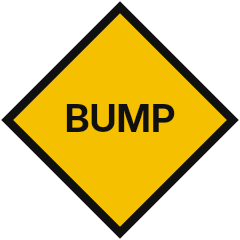
25. Why does this warning matter more on a motorcycle than in a car?
Show answer
Answer B: Because a sudden jolt can unsettle a two-wheeled machine and the rider can lose control
A jolt can push a motorcycle off line or lift a wheel, so a rider slows early, comes slightly off the seat and keeps a relaxed but firm hold on the handlebars.
-
26. A funeral procession with headlights on is crossing an intersection when your light turns green. What should you do?
Show answer
Answer A: Wait and let the whole procession go through
Most states let a funeral procession stay together once the lead vehicle has lawfully entered an intersection, and in every state you must yield to vehicles already in the intersection, so wait until the line has passed.
-
27. On a rural two-lane road you pass small blue signs, each naming one business with an arrow and a distance. What are they?
Show answer
Answer D: Tourist-oriented directional signs for traveler businesses
Tourist-oriented directional signs carry a white legend on blue and are used on rural conventional roads to guide travelers to eligible businesses.
-
28. What do white lane lines painted between travel lanes indicate?
Show answer
Answer A: Traffic in the adjacent lane moves in the same direction as you
White markings separate lanes carrying traffic in the same direction and mark the right edge of the roadway.
-
29. You have entered a work zone where crews are working close to the open lane. What should you do?
Show answer
Answer A: Slow down and be ready for workers and machines
Workers and equipment cross the open lane without warning in a work zone, so reduced speed and attention on the road ahead are what keep them safe.
-
30. You are approaching the crest of a hill and cannot see the road beyond it. What should you do?
Show answer
Answer C: Slow down and keep well to the right
Beyond a blind crest there may be a stopped vehicle, a cyclist or an oncoming driver crossing the center line, so reduce speed and hold your own side.
-
31. You notice that the driver ahead of you is holding a phone to the ear. What should you do?
Show answer
Answer C: Assume slower reactions and leave extra space, or else hold back
A driver on the phone reacts late and misses things, so the safe response is distance rather than a lesson.
-
32. A rectangular red sign with the white words WRONG WAY means that
Show answer
Answer C: the driver is already traveling against the legal flow and must not continue
The wrong way sign uses a white legend and border on red and addresses a driver who has entered a ramp or one-way roadway in the wrong direction, who should stop and turn around safely.
-
33. A driver accumulates ten qualifying traffic judgments in Indiana within a ten year period. How long is the suspension?
Show answer
Answer B: Five years
Ten qualifying judgments within ten years makes a driver a habitual violator under the third category, which carries a five year suspension.
-
34. What is a microsleep?
Show answer
Answer D: A few seconds of sleep, sometimes with the eyes open
A microsleep is an involuntary lapse of a few seconds during which the driver is asleep and the vehicle travels blind, often without the driver knowing.
-
35. What does black ice usually look like from the driver seat?
Show answer
Answer C: A patch of pavement that simply looks wet or slightly glossy
Black ice is clear, so you see the dark road through it and read it as a wet patch. In freezing weather, treat any wet looking patch as ice.
-
36. You are entering an angle parking space on your right. What should you do?
Show answer
Answer C: Stay a little left of the space, then turn in between the lines
Keeping a little left of the space gives the front wheels the room to turn in cleanly and leaves your car centered between the lines.
-
37. You realize you have driven several miles without remembering any of it. What kind of distraction is this?
Show answer
Answer C: Cognitive distraction, because your mind was not on driving
Daydreaming or being lost in thought is a cognitive distraction. Your eyes may be on the road, but your brain is not processing what they see.
-
38. At an intersection where turning on a red arrow is not permitted, the signal shows a red left arrow next to a steady green ball. What may you do?
Show answer
Answer D: Go straight or turn right if permitted, but not left
An arrow controls only the movement it points to, so here the red arrow stops the left turn while the green ball still allows the other movements.
-
39. Which ability does alcohol usually affect first?
Show answer
Answer A: Judgment and self control
Alcohol reduces judgment and inhibition before a drinker notices any clumsiness, which is why an impaired driver often feels perfectly capable while already driving worse.
-
40. You are stopped at a red light ready to turn right when a person pushing a stroller steps into the crosswalk. What should you do?
Show answer
Answer A: Stay stopped until they have crossed your path
A turn on red gives way to every pedestrian in the crosswalk, and someone pushing a stroller has even less room to react.
-
41. You are driving on an open highway in a strong crosswind. What is the safest adjustment?
Show answer
Answer A: Reduce speed and keep a firm grip, expecting gusts on bridges and beside large vehicles
Gusts hit hardest in open gaps, on bridges and when passing high-sided vehicles, so a lower speed and a firm grip let you correct before you are pushed out of your lane.
-
42. You have strapped luggage to the roof rack for a long trip. What should you expect?
Show answer
Answer D: A higher center of gravity, so take the curves and lane changes gently
Weight on the roof raises the center of gravity and makes the vehicle lean and respond more slowly to steering.
-
43. You find that the road surface has turned to sheet ice. What speed is appropriate?
Show answer
Answer A: A crawl, slow enough that you could stop without braking hard
Ice can cut grip to a fraction of normal, so stopping takes many times the usual distance and only a crawl leaves any margin.
-
44. What is Indiana's minimum motor vehicle liability insurance standard?
Show answer
Answer D: $25,000 for one person, $50,000 for two or more people, and $25,000 for property damage
Indiana requires 25/50/25 liability coverage: $25,000 for bodily injury or death of one person, $50,000 for two or more people in one accident, and $25,000 for property damage.
-
45. You are in the right-hand lane of a multilane street and that lane becomes a right-turn-only lane ahead, but you want to go straight. What should you do?
Show answer
Answer B: Change into a through lane before you reach the markings for the turn lane
A lane-use arrow is a regulatory marking, so a driver who wants to continue straight has to leave that lane before it becomes a mandatory turn lane.
-
46. How soon may an applicant retake a failed Indiana driving skills exam?
Show answer
Answer A: After seven days, and after two months following a third failure on a learner's permit
Indiana requires a seven day wait after a failed driving skills exam, and a two month wait after a third failure while holding a learner's permit.
-
47. Which suspension makes an Indiana driver ineligible for specialized driving privileges?
Show answer
Answer A: One imposed for passing a stopped school bus with its stop arm extended
A person suspended under the school bus stop arm statute, like one suspended for refusing a chemical test, is ineligible for specialized driving privileges.
-
48. Within what period must a chemical test be administered after an Indiana officer has probable cause?
Show answer
Answer B: Three hours
A chemical test under the implied consent law must be administered within three hours after the officer had probable cause.
-
49. How often should the spare tire be checked?
Show answer
Answer C: Regularly, because a spare loses pressure while it sits unused
Spares lose air slowly over months, and a flat spare is useless at the moment you need it.
-
50. What administrative penalty does Indiana charge a driver who renews after the license expiration date?
Show answer
Answer B: Six dollars
An individual who fails to renew on or before the expiration date owes the bureau a six dollar administrative penalty.