
Indiana BMV Motorcycle Practice Test 8
- Questions25
- Correct to pass20
- Passing score80%
- Minimum age16 years and 90 days
-
1. You are about to slow down sharply for a turn. Which check comes first?
Show answer
Answer A: A look in the mirror to see how close the traffic behind you is
Any hard slowing needs a mirror check first, because the driver behind is the one who has to react to it.
-
2. What should the clutch be doing during a quick stop?
Show answer
Answer C: Pulled in as the motorcycle slows, so the engine does not stall
Disengaging the clutch as the machine slows keeps the engine running, so the rider can pull away again immediately if that becomes necessary.
-
3. You are turning right where a paved trail crosses the road just past the corner. What should you look for?
Show answer
Answer B: Cyclists and walkers arriving from either direction on the trail
A shared use path carries two-way traffic on foot and on bicycles, so scan both directions along the trail before crossing it.
-
4. You are turning left from a two-way street onto a one-way street. Which lane should you enter?
Show answer
Answer C: The first lane open to traffic on the left side of the one-way street
Turn left from the lane closest to the center line and finish in the first available lane on the left of the one-way street, then change lanes if you need to.
-
5. Your vehicle is burning at the roadside. How far away should everyone keep?
Show answer
Answer D: At least a hundred feet away from the vehicle and upwind, out of the drifting smoke
Burning vehicles give off toxic smoke and parts such as tires and struts can burst, so keep a long distance and stay upwind.
-
6. Why is the staggered formation abandoned in a curve?
Show answer
Answer D: Because each rider needs the full width of the lane to choose a line through the curve
In a curve every rider must be free to use the whole lane to set up an entry and an exit line, which is impossible while holding a fixed side position.
-
7. When may an Indiana vehicle use tire studs that are not retractable?
Show answer
Answer D: From October 1 to the following May 1
Ice grips and tire studs may be used from October 1 to the following May 1, and the projections must not exceed three thirty-seconds of an inch beyond the tread.
-
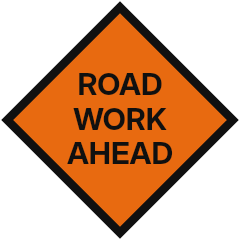
8. Beyond this sign, cones and temporary signs lead traffic along a path that does not agree with the lines painted on the pavement. Which one must the driver follow?
Show answer
Answer C: The temporary arrangement, because it replaces the permanent layout while the work lasts
Temporary traffic control set up for the work takes precedence over the permanent signs and markings, which no longer describe how the road is being used.
-
9. A bike lane on your right is marked with a dashed line for the last stretch before the corner. What does that dashed section allow you to do?
Show answer
Answer D: Merge into the bike lane after checking, and turn right from there
The dashed section is where drivers are meant to merge into the bike lane before turning, which puts cyclists behind the vehicle instead of beside it.
-
10. You are approaching a traffic light that has been green for a long time. How should you treat it?
Show answer
Answer C: Expect it to change and be ready to stop
A light that has been green for a while is called a stale green light. Cover the brake and decide in advance where you could still stop safely.
-
11. A yellow diamond showing a bicycle is posted on a rural road. What should a driver expect?
Show answer
Answer A: Bicyclists crossing or riding along the roadway there
The bicycle warning sign is used where a bikeway crosses the road or where riders are likely to be in the traffic lanes, so drivers should look carefully and pass wide.
-
12. You are turning left from a divided highway through a median opening into a business on the other side. Who has the right of way?
Show answer
Answer C: The traffic on the roadway you are crossing
Turning through a median opening means crossing the opposite roadway, so you yield to all traffic on it before you go.
-
13. Why should a rider avoid riding through a puddle that spans the lane?
Show answer
Answer D: It can hide a deep hole or broken pavement under the surface
Standing water conceals what is underneath it, so treat a puddle as an unknown surface and go around it whenever you safely can.
-
14. You and the driver facing you both have stop signs at a two-way stop. You are going straight and that driver is turning left. Who has the right of way?
Show answer
Answer B: You do, and the turning driver must wait
Between two opposing drivers who both stopped, the one going straight goes first and the left-turning driver yields.
-
15. Two drivers each have three drinks, one over three hours and one in half an hour. What is the difference?
Show answer
Answer C: The fast drinker reaches a higher peak level
The liver removes alcohol at a steady rate, so drinking faster than the body can clear it pushes the blood alcohol level much higher.
-
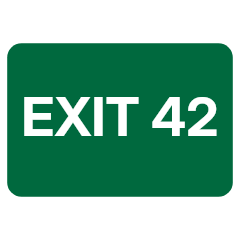
16. Where is signing of this kind normally placed along a freeway?
Show answer
Answer D: Ahead of the interchange and again at the exit, so a driver can reach the correct lane in time
Guide information for an interchange is repeated on the approach and at the ramp, because a driver who learns about the exit only at the last moment has no room left for a safe lane change.
-
17. How much room should a rider try to leave when passing a line of parked cars?
Show answer
Answer A: Enough to clear an opening door, roughly the width of a car door
A door swings out about the width of a door, so ride at least that far from parked vehicles and slow down wherever you cannot leave that much space.
-
18. How much following distance should you keep behind a motorcycle?
Show answer
Answer C: At least three to four seconds
A motorcycle can slow or stop very quickly and is easily upset by a surprise, so allow three to four seconds instead of the usual car gap.
-
19. Which of the four blind spots around a tractor-trailer is the largest?
Show answer
Answer A: The one on the right side of the truck
A truck has no-zones on all four sides, and the right-side blind spot is the largest because it runs back along the trailer and reaches across more than one lane.
-
20. Your left-turn lane shows a flashing yellow arrow. What does that indication allow?
Show answer
Answer B: A left turn after yielding to oncoming traffic and to pedestrians
A flashing yellow arrow marks a permissive left turn: the movement is allowed, but oncoming vehicles and pedestrians keep the right-of-way.
-
21. You are approaching a horse and rider on a country road. What about your horn?
Show answer
Answer C: Do not sound it at all, because the noise can frighten the animal
A startled horse is dangerous to its rider and to you, so pass wide and slow and leave the horn alone.
-
22. Your vehicle has antilock brakes. What should you never do in an emergency stop?
Show answer
Answer A: Pump the pedal up and down
The system already releases and reapplies the brakes many times a second. Pumping the pedal interrupts it and makes the stop longer.
-
23. What is the proper use of the horn?
Show answer
Answer C: To give a brief warning when another road user may not have seen you
The horn is a warning device meant to alert someone to your presence when a collision is possible, and using it in anger tends to escalate conflict rather than prevent crashes.
-
24. What does the choke, or enrichener, do on a motorcycle that has one?
Show answer
Answer B: It gives the engine a richer fuel mixture so a cold engine will start
A cold engine needs more fuel in proportion to air, and the choke supplies that richer mixture until the engine warms up.
-
25. Why should riding gloves fit snugly?
Show answer
Answer C: So loose material does not dull your feel for the controls
Bunched or baggy material gets between your hand and the grip, so a close fitting glove keeps the feel for the throttle, clutch and brake lever.