
Indiana BMV Motorcycle Practice Test 34
- Questions25
- Correct to pass20
- Passing score80%
- Minimum age16 years and 90 days
-
1. A driver is following you far too closely and you have a turn coming up. How should you slow down for it?
Show answer
Answer B: Signal early and slow gradually well before the turn
Early signals and gentle braking give a tailgater the time and distance they have failed to leave for themselves.
-
2. Why do bridges and overpasses deserve extra caution when temperatures are near freezing?
Show answer
Answer A: They lose heat from above and below, so they ice over before the surrounding road
A bridge deck is exposed to cold air on both surfaces and has no ground beneath it to hold heat, so ice can form there while the connecting road is still only wet.
-
3. May you exceed the posted speed limit in order to complete a pass?
Show answer
Answer C: No, the posted limit applies while you are passing too
The limit does not lift for passing; if you cannot complete the pass within it, there is not enough room and you should stay back.
-
4. A driver's blood alcohol concentration is below the legal limit, but the driver is visibly impaired. Can the driver be arrested?
Show answer
Answer C: Yes, driving while impaired by alcohol is an offense at any concentration
The per se figure, 0.08 percent in most states and 0.05 percent in Utah, is the level at which impairment is presumed. Impairment shown by driving behavior and field tests is enough on its own, because alcohol affects skills well before that number.
-
5. A pedestrian signal changes to a flashing upraised hand. What does that indication mean?
Show answer
Answer C: Do not start crossing, but finish a crossing already begun
The flashing upraised hand is the pedestrian change interval: nobody may start to cross, but a pedestrian already in the crosswalk may continue to the far side or to a median.
-
6. A traffic signal is dark and you reach the intersection at the same moment as a vehicle on your right. Who goes first?
Show answer
Answer A: The vehicle on your right, as at any all-way stop
A dark signal is treated as an all-way stop, and the usual tie-breaker then applies: the vehicle on the right goes first.
-
7. Besides motorist services and tourist information, a blue sign background is also used for
Show answer
Answer B: evacuation route signing
Blue is assigned to road user services, tourist information and evacuation routes, so hurricane and other evacuation routes are signed in blue.
-
8. Where should a passenger sit on the motorcycle?
Show answer
Answer A: As far forward as possible without crowding the operator
Sitting well forward keeps the passenger weight close to the center of the motorcycle, which helps it handle closer to normal.
-
9. When are you expected to switch from high beams to low beams?
Show answer
Answer D: When a vehicle approaches from ahead or you come up behind another vehicle
High beams blind other drivers, both those coming toward you and those you follow through their mirrors. Dim them whenever another vehicle is within range.
-
10. The road is icy and visibility is poor, but you are driving at the posted speed limit. Is this acceptable?
Show answer
Answer A: No, because you may never drive faster than is safe for the conditions
Under the basic speed rule a driver must travel at a speed that is reasonable for the actual conditions, so a legal posted speed can still be an unlawful and unsafe speed.
-
11. You are already inside a roundabout when an emergency vehicle approaches with lights and siren. What should you do?
Show answer
Answer B: Continue to your exit, leave the roundabout, then pull over and stop
Stopping inside a roundabout blocks the circulating roadway, so you should exit first and then pull over clear of the intersection.
-
12. You notice at night that one of your headlights has burned out. What should you do?
Show answer
Answer B: Get it replaced promptly, because other drivers may take you for a motorcycle
A single light makes your vehicle look narrower and further away, so other drivers misjudge you, and one light is also illegal.
-
13. You are descending a long steep grade with a loaded truck close behind you. What should you do?
Show answer
Answer A: Hold a steady speed and let it pass when it can
Gravity pushes a loaded truck downhill and it cannot slow quickly, so give it a predictable speed and room to get by rather than braking in front of it.
-
14. A vehicle in the lane beside you has stopped at a crosswalk. What should you do?
Show answer
Answer C: Stop as well, because that driver may be yielding to a pedestrian you cannot see
The stopped vehicle hides the crosswalk from you, and passing it is a leading cause of collisions with pedestrians who are already crossing.
-
15. The driver of a slow farm vehicle moves partly onto the shoulder and waves you past. Who is responsible for the pass?
Show answer
Answer A: You are, so pass only if you can see that the road is clear
A courtesy wave is not a traffic control, and the driver who changes lanes is the one answerable for the maneuver.
-
16. What is the purpose of a wide solid white line painted straight across your lane on the approach to an intersection?
Show answer
Answer C: It shows the point where a required stop must be made
A stop line indicates the point at which the stop required by a signal or a stop sign is to be made, ahead of the crosswalk and the intersection.
-
17. Another driver takes a right of way that was legally yours. What should you do?
Show answer
Answer A: Give way to the other driver and avoid the crash, whatever the law says
Right of way is something you give, not something you take, and being in the right is no protection in a collision.
-
18. How often should you check your mirrors while driving?
Show answer
Answer C: Every few seconds, so you always know what is around you
Traffic behind and beside you changes constantly. Frequent, brief mirror checks keep a picture of your surroundings current so nothing surprises you.
-
19. At an intersection where turning on a red arrow is not permitted, the signal shows a red left arrow next to a steady green ball. What may you do?
Show answer
Answer D: Go straight or turn right if permitted, but not left
An arrow controls only the movement it points to, so here the red arrow stops the left turn while the green ball still allows the other movements.
-
20. You are on an entrance ramp joining a busy freeway. What should you do with your speed in the acceleration lane?
Show answer
Answer D: Build it up to about the speed of the traffic you are joining
Merging works when your speed matches the traffic stream, because a large speed difference forces the drivers already on the freeway to brake or swerve.
-
21. On a regulatory sign, what does a red circle with a diagonal slash drawn over a symbol mean?
Show answer
Answer D: The movement or action shown by the symbol is prohibited
A red circle with a diagonal slash is the standard way of showing that the movement pictured inside it, such as a U-turn or a right turn, is not allowed.
-
22. When must a passenger keep both feet on the footrests?
Show answer
Answer C: At all times, including while the motorcycle is stopped
Feet stay on the footrests even at a stop, because a foot put down or swung out can unbalance the motorcycle or be caught by the road.
-
23. You are on a two-lane road where a broken yellow line runs on your side of the center. What does that pattern allow?
Show answer
Answer C: Passing when the way ahead is clear and it is otherwise legal
A broken yellow center line marks a stretch where passing is permitted for traffic on that side when it can be completed safely.
-
24. How should speed and following distance be adjusted beyond this sign?
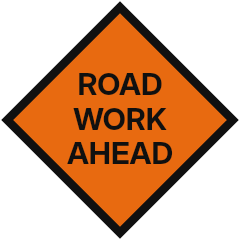
Show answer
Answer D: Cut speed and leave a longer gap, because traffic can stop without warning
Traffic in these areas stops and starts unexpectedly and there is little room to steer around a problem, so extra space is what prevents a rear-end collision.
-
25. A car in the lane to your left keeps drifting toward the line between you. Which portion of your lane should you move to?
Show answer
Answer A: The right portion
Moving to the far side of your lane buys distance and time if that driver keeps coming, and it may also make the motorcycle visible to a driver who had not noticed it.